
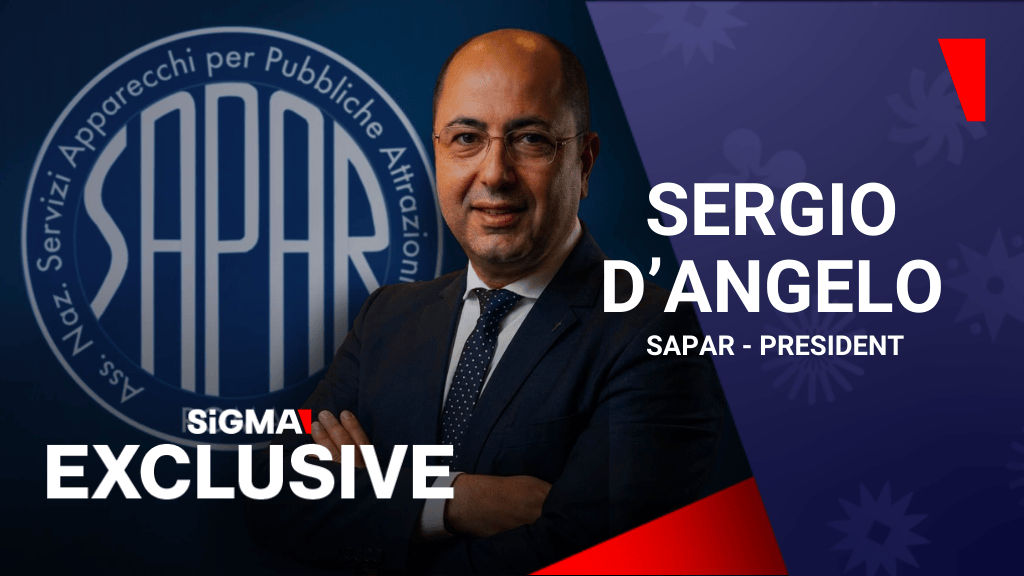
 Sharing, dialogue and an industrial vision that looks beyond regulatory emergency. In his first six months at the helm of SAPAR, the National Association of Amusement Machine Operators, President Sergio D’Angelo has set out a clear direction based on internal cohesion and structured engagement with institutions and local communities. It is a decisive shift at a crucial moment for the legal gaming sector, which is facing the reform of land-based gambling, technological innovation and a public narrative that is often hostile or misleading.
An association “in motion”: the turning point of the first six months
In reviewing the early phase of his mandate, D’Angelo speaks explicitly of a “new path” for SAPAR. One that starts from within and is built around a single key concept: sharing. “The watchword of SAPAR’s new course is sharing and dialogue,” the President explains, clarifying that his role is “to gather and bring together the needs of all the Association’s members”.
This is a process that involves the entire organisational structure and aims to develop a unified position to be presented to political and institutional decision-makers. “An internal sharing process whose objective is dialogue with institutions and politics, in order to define balanced and effective solutions that respect all needs,” D’Angelo says. SAPAR, he adds, cannot afford to stand still. “In short, a SAPAR in motion because, as a well-known saying goes, ‘those who stop are lost’.”
Land-based gambling reform: SAPAR’s red line
The reform of land-based gambling remains the most sensitive issue on the table. At ENADA Workshop 2025, D’Angelo drew a clear red line, calling for full legal recognition of operators and the centrality of the Italian supply chain. If invited to a government technical roundtable, he would bring forward precise and non-negotiable priorities.
“The main points we bring to political and institutional tables are actually four: greater player safety, more entertainment, a better balance in taxation, and respect for state revenues,” he states. Added to these is environmental sustainability, which completes the profile of the new AWP presented by SAPAR at ENADA 2025. “This new AWP proves that all these points already have a viable solution,” D’Angelo explains, concluding with a clear message: “For us at SAPAR, the future has already begun.”
Operators as an economic and social safeguard for local communities
One of the strongest messages reiterated by D’Angelo concerns the role of operators as an industrial and social safeguard of legal gaming. In recent years, he notes, the sector has been asked to shoulder significant responsibilities. “Operators have been asked to invest, to train, to take responsibility and to make sacrifices,” he recalls, stressing that it was operators who enabled “the transition from illegal physical gambling to legal gambling” starting in the early 2000s.
The figures tell a story that is often absent from public debate. “Over the past 20 years, the amusement sector has allowed the State to collect around €100 billion,” D’Angelo highlights, adding that today it remains “the largest contributor, accounting for 36% of total gaming tax revenues, with a collection equal to 10% of all State games in Italy”. Without operators, he warns, “there would be neither innovation nor sustainability for the entire supply chain”, and the risk would be “a resurgence of illegal gambling, with dangerous consequences for players, businesses and the Treasury”.
Local authorities and a ‘traffic-light’ regulatory framework
Dialogue with local authorities represents another strategic pillar of SAPAR’s new direction. Meetings with institutional stakeholders, including at the ANCI annual assembly, have highlighted a fragmented regulatory landscape. “In recent years, Italy has become marked by a patchwork of regulations,” the President explains, referring to “red zones characterised by a form of prohibitionism, yellow zones with partially restrictive measures, and green zones where employment and industrial needs are taken into account”.
According to D’Angelo, this creates significant distortions. “A kind of regulatory traffic light system that, in many cases, prevents two similar businesses, perhaps only a few kilometres apart, from operating under the same conditions.” SAPAR is therefore calling for more balanced and non-discriminatory policies that do not selectively penalise legal public gaming.
Distance limits, data and the failure of prohibitionism
On the issue of distance restrictions, D’Angelo refers to scientific evidence that is often overlooked. “In 2018, the Italian National Institute of Health presented the most detailed study on gambling ever published in Italy,” he recalls, noting that the research showed how distance limits “had the opposite effect to the one for which they were introduced”.
Problem gamblers, he explains, “prefer to play far from places where they might be recognised”, and pushing gaming venues out of urban areas can actually encourage riskier behaviour. While acknowledging the ethical value of such measures for protecting younger people and vulnerable groups, D’Angelo is clear that “combating gambling addiction requires education and information, not prohibitionism, which history has shown to be a failure”.
Technological innovation and parity with online gaming
Looking to the future of entertainment, D’Angelo describes an advanced AWP that is “a concentration of technology serving safety and enjoyment”, while also respecting the needs of operators. In this evolving landscape, the relationship between online and land-based gaming must fundamentally change. “The relationship between online and land-based gaming must become a level playing field,” he insists, pointing to a system currently skewed “in terms of payout and taxation” in favour of digital platforms.
Sector reputation and SAPAR’s active role
The President does not shy away from addressing the sector’s reputational challenges. “Today, at a global level, the gaming sector suffers from an evident reputation problem,” he states, noting how legal and illegal gambling are often conflated in public discourse. SAPAR, he says, intends to actively counter this narrative.
“We are not abstract entities: we are present in local communities and, as such, we are also a safeguard of legality,” D’Angelo affirms. When distorted representations emerge, the Association responds “by requesting corrections and providing data and arguments to restore an accurate picture”, with the aim of affirming “the dignity of our work and the legitimacy of a sector that deserves respect”.
Made in Italy, operators and the global challenge
Within the reform process, one of the greatest risks is that Italian operators could be squeezed between multinational corporations and digital platforms. “Safeguarding operators means safeguarding Made in Italy,” the President asserts, describing them as true “artisans of gaming”, whose value lies in their relationship with users and in protecting public interests.
SAPAR’s vision also extends beyond national borders. “For too many years, Italian gaming companies have remained within national boundaries,” D’Angelo observes, outlining the intention to “build networks and act collectively”, guiding member companies towards international markets, including through opportunities offered by SiGMA events.
“The future has already begun”
In his closing remarks, Sergio D’Angelo encapsulates the spirit of his presidency with a powerful quotation. “The future begins today, not tomorrow,” said Pope John Paul II. “As President of SAPAR, I say: the future has already begun,” D’Angelo concludes. A statement that captures the ambition of an association determined to play a central role in shaping the present – and the future – of Italy’s legal gaming industry.
Written by Tony Colapinto